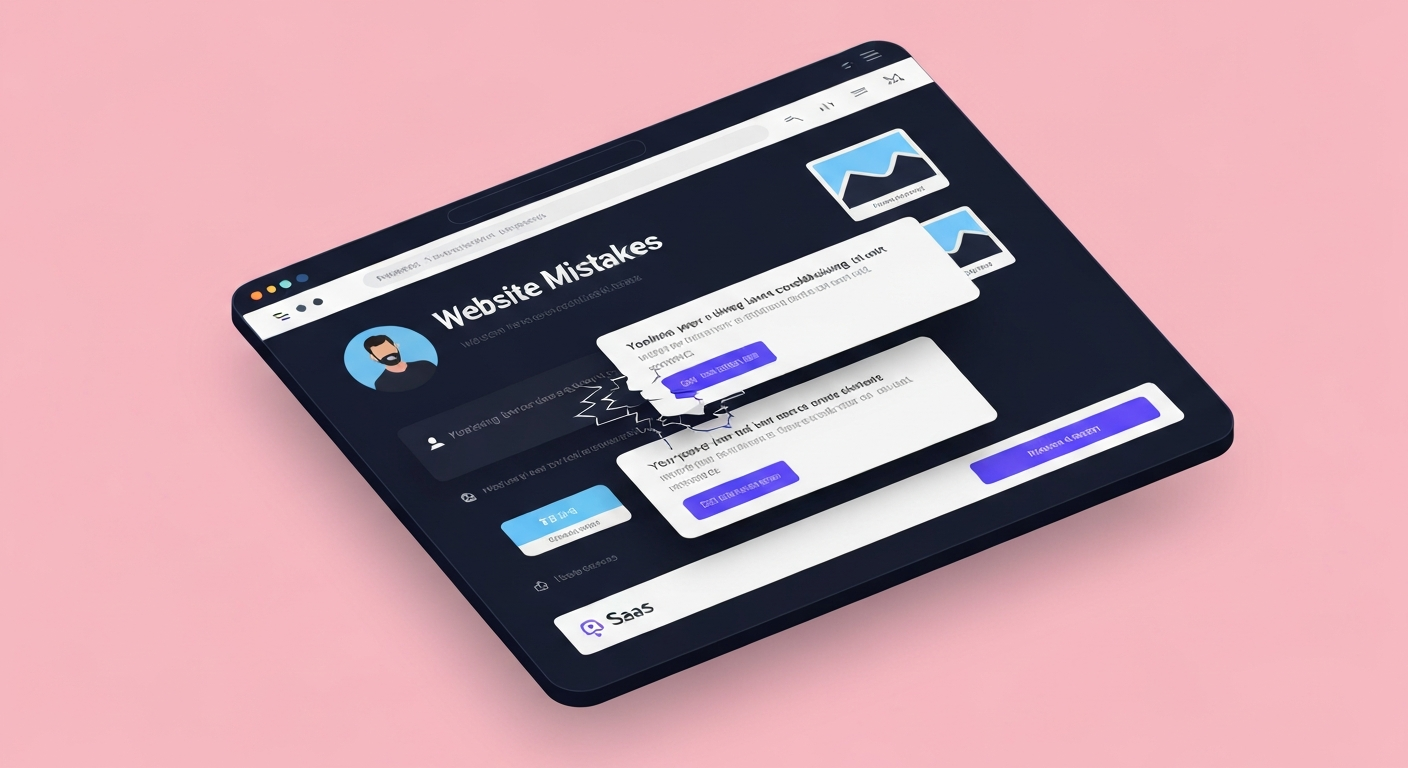
Your website is either your best salesperson or your biggest liability — there is no neutral. Every day your website has critical flaws, you're losing potential customers to competitors who've done the work to get it right. The painful reality is that most of these problems are invisible to the business owner but immediately obvious to every visitor.
Here are the ten website mistakes that most commonly cost businesses customers, along with exactly what to do to fix each one.
Mistake 1: No Clear Value Proposition Above the Fold
The most important piece of real estate on your website is the area visible when the page first loads — before any scrolling. If a visitor can't immediately understand what you do, who you do it for, and why they should care, they leave. Studies show the average visitor decides whether to stay or go within 8 seconds.
Your hero section needs to answer three questions instantly: What do you offer? Who is it for? What's the key benefit? "Business consulting services" fails. "We help e-commerce brands scale to 7 figures using paid advertising — without burning your budget" succeeds. Be specific, be benefit-focused, and be immediate.
Mistake 2: Slow Page Load Speed
Google research shows 53% of mobile visitors abandon sites that take more than three seconds to load. Beyond user experience, page speed directly affects your search rankings — Google explicitly uses Core Web Vitals performance metrics as ranking signals.
Common speed killers include unoptimized images (use WebP format with srcset), excessive JavaScript, too many third-party plugins, and slow hosting. Run your site through Google PageSpeed Insights and address every "Opportunity" flagged in the report. A professional website build should include performance optimization as standard.
Mistake 3: No Mobile Optimization
More than 60% of web traffic comes from mobile devices in 2025. A website that looks great on desktop but is clunky, hard to navigate, or slow on mobile is alienating the majority of your visitors. Google penalizes poor mobile experiences in search rankings.
Test your website on actual mobile devices (not just browser emulators) by trying to complete your own contact form, navigate your services, and find pricing. Where do you get frustrated? Those are conversion leaks costing you customers every single day.
Mistake 4: Weak or Missing Calls to Action
A website without clear, compelling calls to action is a brochure. Brochures don't generate revenue. Every page on your website should guide visitors toward the next logical step in your customer journey.
Your CTAs should be: visually prominent (contrasting button color), specific ("Get Your Free Quote" not "Click Here"), benefit-focused (emphasize what the visitor gets), and strategically placed (not just at the bottom of the page after visitors have already bounced). Test different CTA copy — even small wording changes can produce significant conversion rate improvements.
Mistake 5: No Social Proof
People don't trust businesses — they trust other people's experiences with businesses. In the absence of social proof, potential customers are forced to evaluate your claims with no independent validation. This dramatically increases perceived risk and reduces conversion rates.
Social proof includes: client testimonials (with full names and companies, not vague initials), case studies showing specific results, logos of notable clients, media mentions, star ratings, and number of customers served. Don't bury social proof at the bottom of your page — put it near your key CTAs where trust matters most.
Mistake 6: Unclear or Missing Pricing Information
Many businesses hide their pricing because they're afraid to lose prospects before they have a chance to make their pitch. This strategy backfires. Prospects who can't find pricing information are more likely to leave your site and find a competitor who is transparent — not more likely to call you.
You don't need to show exact line-item pricing for every scenario. But give visitors enough information to self-qualify: is this in my budget? For our approach to transparent pricing, see our pricing page as a model for how to present pricing clearly while communicating value.
Mistake 7: Poor Navigation Architecture
If visitors can't find what they're looking for within two clicks, they leave. Common navigation mistakes include too many menu items (cognitive overload), vague menu labels ("Solutions" instead of "Services"), no clear path to the most important action (buy, contact, book), and inconsistent navigation across pages.
Simplify your navigation to reflect the most common visitor journeys. Test your navigation with real people who don't know your site — watch where they get confused and fix those points.
Mistake 8: No SEO Foundation
A beautiful website that no one can find is a very expensive brochure. Without basic on-page SEO — unique page titles, meta descriptions, proper heading hierarchy, keyword optimization, image alt text, and a structured internal linking strategy — your site won't appear in search results for the queries your potential customers are using.
Start with keyword research: what terms does your ideal customer search when they need what you offer? Make sure your key pages are optimized for those terms. This is a foundational activity that pays compounding dividends over time.
Mistake 9: Outdated or Generic Content
Stock photos of people shaking hands in suits, generic industry buzzwords, and template copy that could describe any business in your category are conversion killers. Visitors are smart — they can tell when a website is genuinely trying to communicate with them versus when it's recycled from a template.
Use real photos of your work, your team, and your clients (with permission). Write copy that speaks specifically to your target customer's real pain points in their own language. Show specific results, not vague promises. Specificity is credibility.
Mistake 10: No Analytics or Conversion Tracking
If you don't know how your website is performing, you can't improve it. Yet many small businesses have no analytics setup — or have Google Analytics installed but never look at it. Without data, you're flying blind, unable to identify where visitors are dropping off, which pages are converting, or what content is driving leads.
At minimum, install Google Analytics 4 and set up conversion events for all your key actions: form submissions, phone clicks, purchase completions. Review your analytics monthly. Look for pages with high exit rates, low time on page, and poor conversion rates — these are your optimization opportunities.
Your Website Deserves an Upgrade
If you recognized your website in multiple items on this list, the fastest path to fixing all of them is a complete rebuild with conversion and performance as foundational priorities. Our Novus Pathway packages deliver a professionally designed, SEO-optimized, mobile-first website that's built to convert visitors into customers from day one.
Infrastructure Deployment
Ready to Deploy Your AI Infrastructure?
Build a scalable business operating system designed for modern growth.